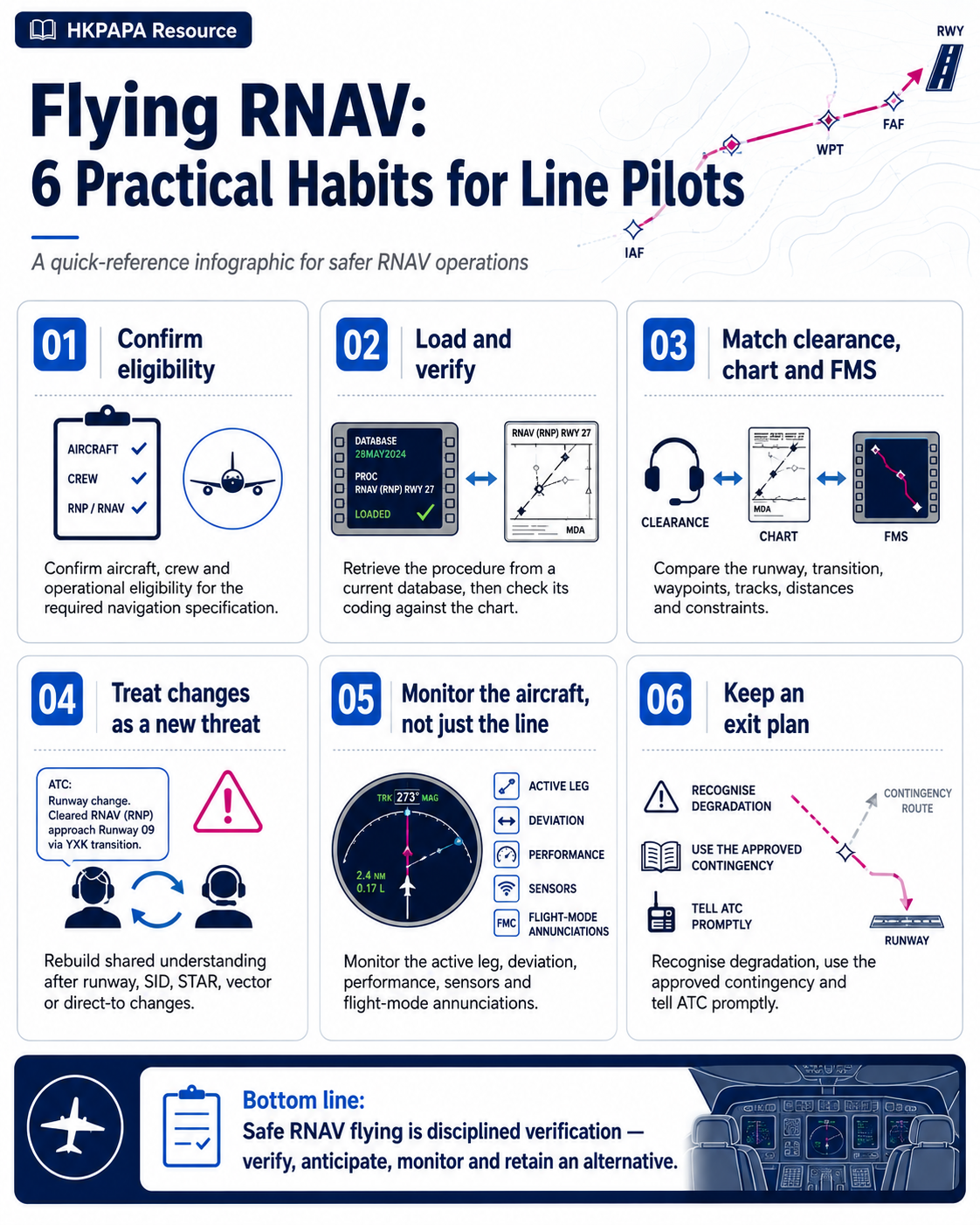
Six habits for safer RNAV operations
Confirm eligibility
Confirm aircraft, crew and operational eligibility for the required navigation specification.
Load and verify
Retrieve the procedure from a current database, then check its coding against the chart.
Match clearance, chart and FMS
Compare the runway, transition, waypoints, tracks, distances and constraints.
Treat changes as a new threat
Rebuild shared understanding after runway, SID, STAR, vector or direct-to changes.
Monitor the aircraft, not just the line
Monitor the active leg, deviation, performance, sensors and flight-mode annunciations.
Keep an exit plan
Recognise degradation, use the approved contingency and tell ATC promptly.
RNAV visual briefing
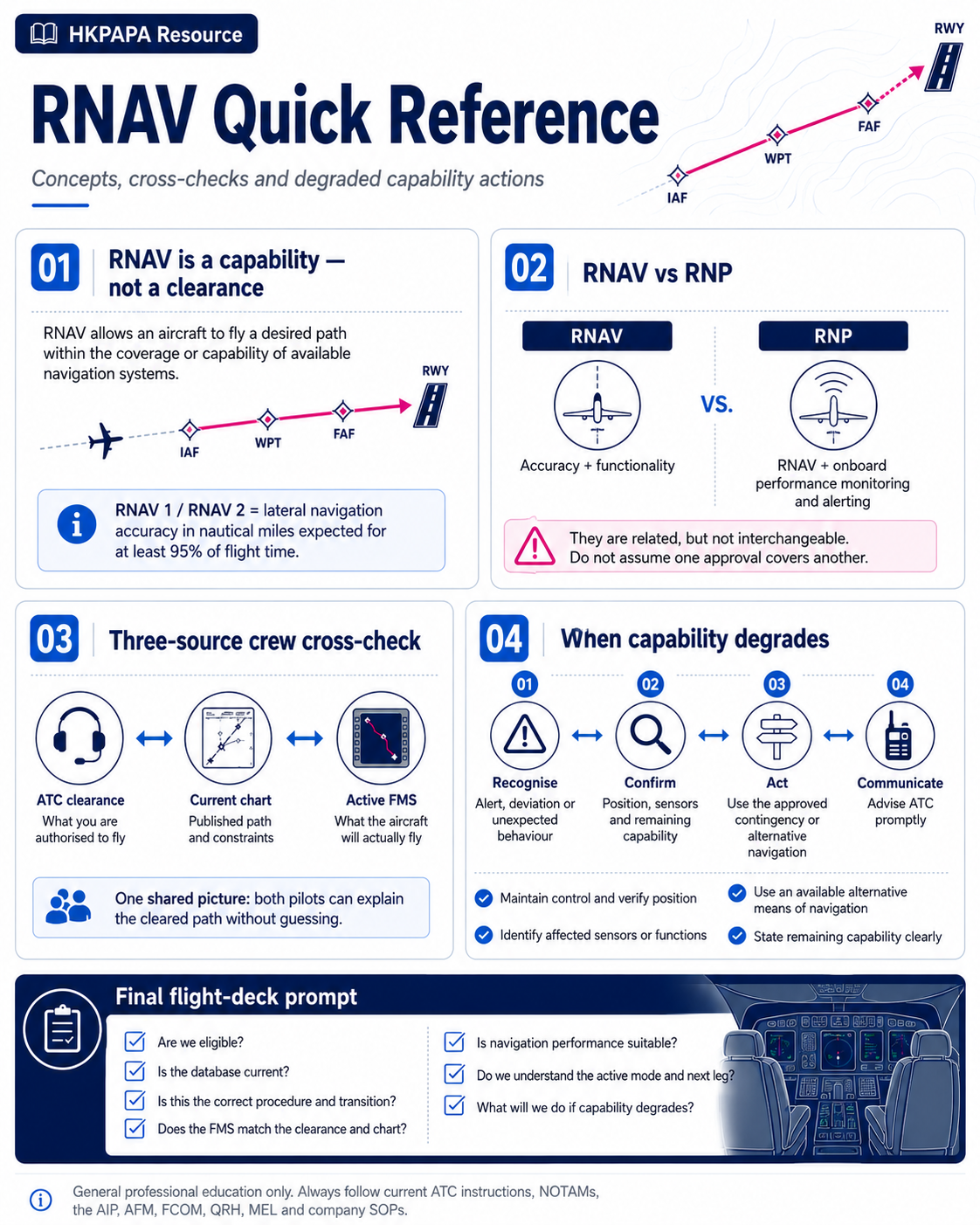
Keep these two illustrated references handy for the core concepts, cross-checks and practical habits covered in this guide.
RNAV is a capability—not a clearance
Area navigation allows an aircraft to fly a desired path within the coverage or capability of ground-based, space-based or self-contained navigation systems, or a combination of them.
Within performance-based navigation, an RNAV specification states the required navigation performance and functionality for a particular operation. The number in RNAV 1 or RNAV 2 refers to the lateral navigation accuracy, in nautical miles, expected to be achieved for at least 95% of flight time.
RNAV and RNP are not interchangeable. RNP includes onboard performance monitoring and alerting; an RNAV specification does not necessarily provide that protection. An aircraft capable of one specification should not automatically be assumed eligible for another.
The applicable AFM or approved aircraft documentation, operational approval, MEL and company procedures establish what your operation may actually conduct.
Source concept: ICAO PBN Manual and FAA AIM. See references below.
1. Establish eligibility before relying on the system
Begin with the requirement shown on the chart, route or applicable aeronautical publication. Then confirm that the aircraft’s approved documentation supports that specification and any additional functionality required.
Consider the serviceability of the navigation sensors and equipment, relevant MEL restrictions, navigation-aid availability and applicable NOTAMs. A route displayed by the FMS is not, by itself, evidence of operational eligibility.
If a required procedure is absent from the database, do not assume that manually constructing it creates an equivalent approved procedure. Resolve the discrepancy using company procedures.
2. Verify the loaded procedure
After loading the route or procedure, compare the active flight plan with the chart and clearance.
The verification should include, as applicable:
Departure or arrival runway
Procedure name and revision
Selected transition
Waypoint sequence
Track angles and distances
Altitude and speed constraints
Discontinuities
Fly-by or fly-over waypoints
Any special sensor or functional requirement
For database procedures, avoid manually inserting or changing coded waypoints unless the approved procedure and company guidance specifically permit the intended action.
A useful crew check is simple:
Reflection promptWhere are we now? Where is the aircraft going next? What will it do after that?
Both pilots should be able to answer without guessing.
One cleared path Both pilots can explain it without guessing.
Operational summary based on ICAO, EASA and FAA guidance. See references below.
3. Understand what ATC has changed
Late changes deserve deliberate attention. A different runway, shortened arrival, direct-to clearance or radar vector may remove legs, alter turn anticipation or leave an unexpected discontinuity.
Before execution, confirm:
The clearance has been correctly understood.
The intended modification matches the clearance.
The resulting path is sensible.
Terrain, altitude and speed implications have been considered.
The correct leg is active.
The aircraft will intercept the intended route appropriately.
The exact method of entry, cross-check and execution must follow the operator’s task-sharing procedures. If the change cannot be entered and verified safely at that moment, ask ATC for time or a simpler clearance.
4. Monitor the operation continuously
Loading and checking the procedure is only the beginning. During flight, monitor the aircraft’s position relative to the desired path and confirm that the displayed navigation performance remains suitable for the operation.
Maintain awareness of:
Active and next waypoints
Cross-track deviation
Navigation accuracy or estimated position uncertainty, where displayed
Sensors contributing to the navigation solution
Flight director or autopilot modes
Waypoint sequencing and turn behaviour
Unexpected map shifts, alerts or disagreeing information
Automation should reduce workload without removing scrutiny. The flight crew remains responsible for recognising when the aircraft is not following the expected path.
5. Prepare for degraded capability
Before entering a demanding terminal environment, know what the operation requires if navigation capability is lost or degraded.
Depending on the aircraft, airspace and procedure, this may mean reverting to another navigation source, requesting vectors, accepting a conventional procedure or discontinuing the operation.
If PBN capability is lost:
Maintain control and verify the aircraft’s actual position.
Identify which sensors or functions have been affected.
Apply the approved abnormal or contingency procedure.
Use an available alternative means of navigation.
Notify ATC promptly and state the remaining capability clearly.
Do not continue simply because the map still looks reasonable. A convincing display can still be based on compromised information.
- 01RecogniseAlert, deviation or unexpected behaviour
- 02ConfirmPosition, sensors and remaining capability
- 03ActUse the approved contingency or alternative navigation
- 04CommunicateAdvise ATC promptly
Apply your aircraft and operator procedures. See references below.
Final flight-deck prompt
Before relying on RNAV guidance, ask:
Are we eligible?
Is the database current?
Is this the correct procedure and transition?
Does the FMS match the clearance and chart?
Is the navigation performance suitable?
Do we understand the active mode and next leg?
What will we do if the capability degrades?
Good RNAV flying is disciplined systems management: verify, anticipate, monitor and retain an alternative.